 bdf23e66d1
## What this PR does Closes #2412. On a cold tenant-Kubernetes bootstrap, the parent HelmRelease raced the admin-kubeconfig Secret that Kamaji provisions asynchronously. Three CP-side Deployments (cluster-autoscaler, kccm, kcsi-controller) mounted that Secret as a hard volume, flux helm-controller's default wait budget was too short for Kamaji cold start, and `install.remediation { retries: -1 }` then uninstalled the Cluster CR and restarted the cycle forever. Implements a defense-in-depth fix: - `optional: true` on the admin-kubeconfig Secret volume in all three Deployments so kubelet no longer FailedMounts while Kamaji is still bootstrapping. - A shared `wait-for-kubeconfig` init container (in `templates/_helpers.tpl`) that polls for `super-admin.svc` with a 10m deadline, strictly below the HelmRelease Install.Timeout so a broken tenant falls into CrashLoopBackOff visibly instead of hanging forever. - Per-Application HelmRelease Install/Upgrade timeout, driven by a new `release.cozystack.io/helm-install-timeout` annotation on ApplicationDefinition. Kubernetes-rd sets it to `15m`; other kinds leave it unset and keep flux defaults, so their failed installs remediate on the normal cadence. Parser rejects ns/us/µs (accepted by `time.ParseDuration`, rejected by Flux's CRD pattern) at startup. - Soft-skip when `_namespace.etcd` is empty: the CP-side Deployments, the Cluster/KamajiControlPlane/KubevirtCluster/WorkloadMonitor CRs, and every child HelmRelease that references admin-kubeconfig now render only when an etcd DataStore exists for this tenant. An `awaiting-etcd` ConfigMap is emitted as a user-visible status beacon so `helm install` still succeeds and flux retries on its 5m interval until the Tenant chart catches up. - e2e remediation guard built on `.status.history[].status` (the Snapshot shape), not on `.status.installFailures` - `ClearFailures()` zeroes the latter on every successful reconciliation, which made the previous guard vacuous. Tests: - Go unit tests for the annotation parser (accepted/rejected units) and the HR builder (table-driven across kinds). - helm unittest for the per-template structure (optional volume, init container, dataStoreName, awaiting-etcd beacon). - bats unit tests for the shell guard (every combination of empty/zero/positive history entries, plus pinned HR v2 shape). - Chart-wide bats invariants: every Deployment mounting admin-kubeconfig has the guards; zero such Deployments and zero HelmReleases render when etcd is empty. All wired into the existing `make unit-tests` target (`go-unit-tests` added alongside `helm-unit-tests` and `bats-unit-tests`). Option 2 from the ticket (separate HelmRelease with `dependsOn`) was intentionally not taken: the combination above closes the same race without restructuring the chart's HelmRelease topology. ### Release note ```release-note fix(kubernetes): close admin-kubeconfig race on tenant Kubernetes bootstrap. The parent HelmRelease no longer enters an uninstall/retry cycle when Kamaji control-plane cold start exceeds flux's default wait budget. A Kubernetes tenant created before the parent Tenant application has etcd enabled now renders only an awaiting-etcd beacon ConfigMap and waits quietly for the DataStore to appear, instead of producing half-installed Deployments that CrashLoopBackOff forever. ``` <!-- This is an auto-generated comment: release notes by coderabbit.ai --> ## Summary by CodeRabbit * **New Features** * Per-application Helm install/upgrade timeout via metadata annotation. * Init-container guards that wait for admin kubeconfig before workloads start. * Chart resources now render conditionally based on etcd presence. * **Tests** * Helm-template tests for admin-kubeconfig invariants and remediation-cycle detection. * New Go unit tests and CI Helm/unittest coverage plus test value files. * **Chores** * Added BusyBox image pin and new Makefile test targets (including Go unit-tests). <!-- end of auto-generated comment: release notes by coderabbit.ai --> |
||
|---|---|---|
| .gemini | ||
| .github | ||
| api | ||
| cmd | ||
| dashboards | ||
| docs | ||
| examples/backups/vmi | ||
| hack | ||
| img | ||
| internal | ||
| packages | ||
| pkg | ||
| tools/openapi-gen | ||
| .coderabbit.yaml | ||
| .gitignore | ||
| .pre-commit-config.yaml | ||
| ADOPTERS.md | ||
| AGENTS.md | ||
| CODE_OF_CONDUCT.md | ||
| CONTRIBUTING.md | ||
| CONTRIBUTOR_LADDER.md | ||
| go.mod | ||
| go.sum | ||
| GOVERNANCE.md | ||
| LICENSE | ||
| MAINTAINERS.md | ||
| Makefile | ||
| README.md | ||
| SECURITY.md | ||







Cozystack
Cozystack is a free platform and framework for building clouds.
Cozystack is a CNCF Sandbox Level Project that was originally built and sponsored by Ænix.
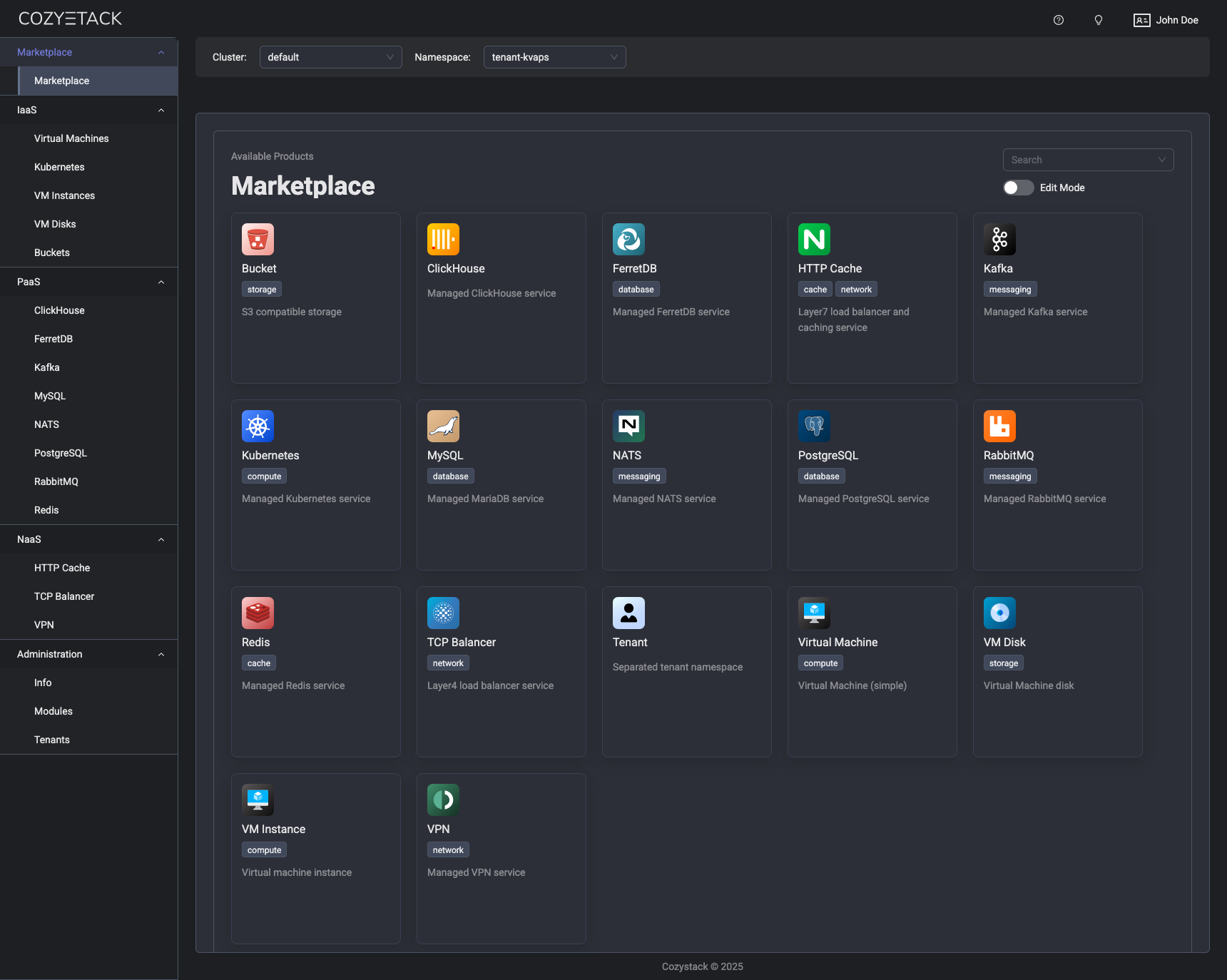
With Cozystack, you can transform a bunch of servers into an intelligent system with a simple REST API for spawning Kubernetes clusters, Database-as-a-Service, virtual machines, load balancers, HTTP caching services, and other services with ease.
Use Cozystack to build your own cloud or provide a cost-effective development environment.
Use-Cases
-
Using Cozystack to build a public cloud
You can use Cozystack as a backend for a public cloud -
Using Cozystack to build a private cloud
You can use Cozystack as a platform to build a private cloud powered by Infrastructure-as-Code approach -
Using Cozystack as a Kubernetes distribution
You can use Cozystack as a Kubernetes distribution for Bare Metal
Documentation
The documentation is located on the cozystack.io website.
Read the Getting Started section for a quick start.
If you encounter any difficulties, start with the troubleshooting guide and work your way through the process that we've outlined.
Versioning
Versioning adheres to the Semantic Versioning principles.
A full list of the available releases is available in the GitHub repository's Release section.
Contributions
Contributions are highly appreciated and very welcomed!
In case of bugs, please check if the issue has already been opened by checking the GitHub Issues section. If it isn't, you can open a new one. A detailed report will help us replicate it, assess it, and work on a fix.
You can express your intention to on the fix on your own. Commits are used to generate the changelog, and their author will be referenced in it.
If you have Feature Requests please use the Discussion's Feature Request section.
Community
You are welcome to join our Telegram group and come to our weekly community meetings. Add them to your Google Calendar or iCal for convenience.
License
Cozystack is licensed under Apache 2.0.
The code is provided as-is with no warranties.
Commercial Support
A list of companies providing commercial support for this project can be found on official site.