 bdaaae92e2
## Summary Add `serverName` field to bootstrap configuration to support backup recovery when the Barman server name in `backup.info` differs from the Kubernetes cluster name. This fixes "no target backup found" errors during CloudNativePG recovery operations. ## Problem CloudNativePG forms the backup path as `destinationPath + "postgres-" + oldName`, but searches for backups using the `server_name` field from `backup.info`. When these values don't match (e.g., cluster name is `grafana` but `server_name` is `cloud`), recovery fails with "no target backup found". ## Solution - Add optional `serverName` parameter to `bootstrap` configuration - When specified, CloudNativePG uses this value to search for backups in S3 - Falls back to `oldName` when `serverName` is not provided (backwards compatible) ## Changes - Add `ServerName` field to PostgreSQL CRD type definition - Add conditional `serverName` to Cluster `externalClusters` template - Update `values.yaml` and README.md with `serverName` documentation - Regenerate `values.schema.json` and `postgres.yaml` CRD ## Test plan - [ ] Deploy postgres cluster with backups enabled - [ ] Create backup - [ ] Create new postgres instance with `bootstrap.enabled=true`, `bootstrap.oldName=<original-name>`, and `bootstrap.serverName=<value-from-backup.info>` - [ ] Verify recovery completes successfully <!-- This is an auto-generated comment: release notes by coderabbit.ai --> ## Summary by CodeRabbit * **New Features** * Added an optional bootstrap.serverName setting to specify the Barman server name from the original cluster’s backup.info (used when that server name differs from the Kubernetes cluster name). * **Documentation** * Clarified that bootstrap.oldName must match the serverName value recorded in backup.info; updated docs and examples to reflect the new bootstrap.serverName option. <!-- end of auto-generated comment: release notes by coderabbit.ai --> |
||
|---|---|---|
| .gemini | ||
| .github | ||
| api | ||
| cmd | ||
| dashboards | ||
| docs | ||
| examples/backups/vmi | ||
| hack | ||
| img | ||
| internal | ||
| packages | ||
| pkg | ||
| tools/openapi-gen | ||
| .coderabbit.yaml | ||
| .gitignore | ||
| .pre-commit-config.yaml | ||
| ADOPTERS.md | ||
| AGENTS.md | ||
| CODE_OF_CONDUCT.md | ||
| CONTRIBUTING.md | ||
| CONTRIBUTOR_LADDER.md | ||
| go.mod | ||
| go.sum | ||
| GOVERNANCE.md | ||
| LICENSE | ||
| MAINTAINERS.md | ||
| Makefile | ||
| README.md | ||
| SECURITY.md | ||







Cozystack
Cozystack is a free platform and framework for building clouds.
Cozystack is a CNCF Sandbox Level Project that was originally built and sponsored by Ænix.
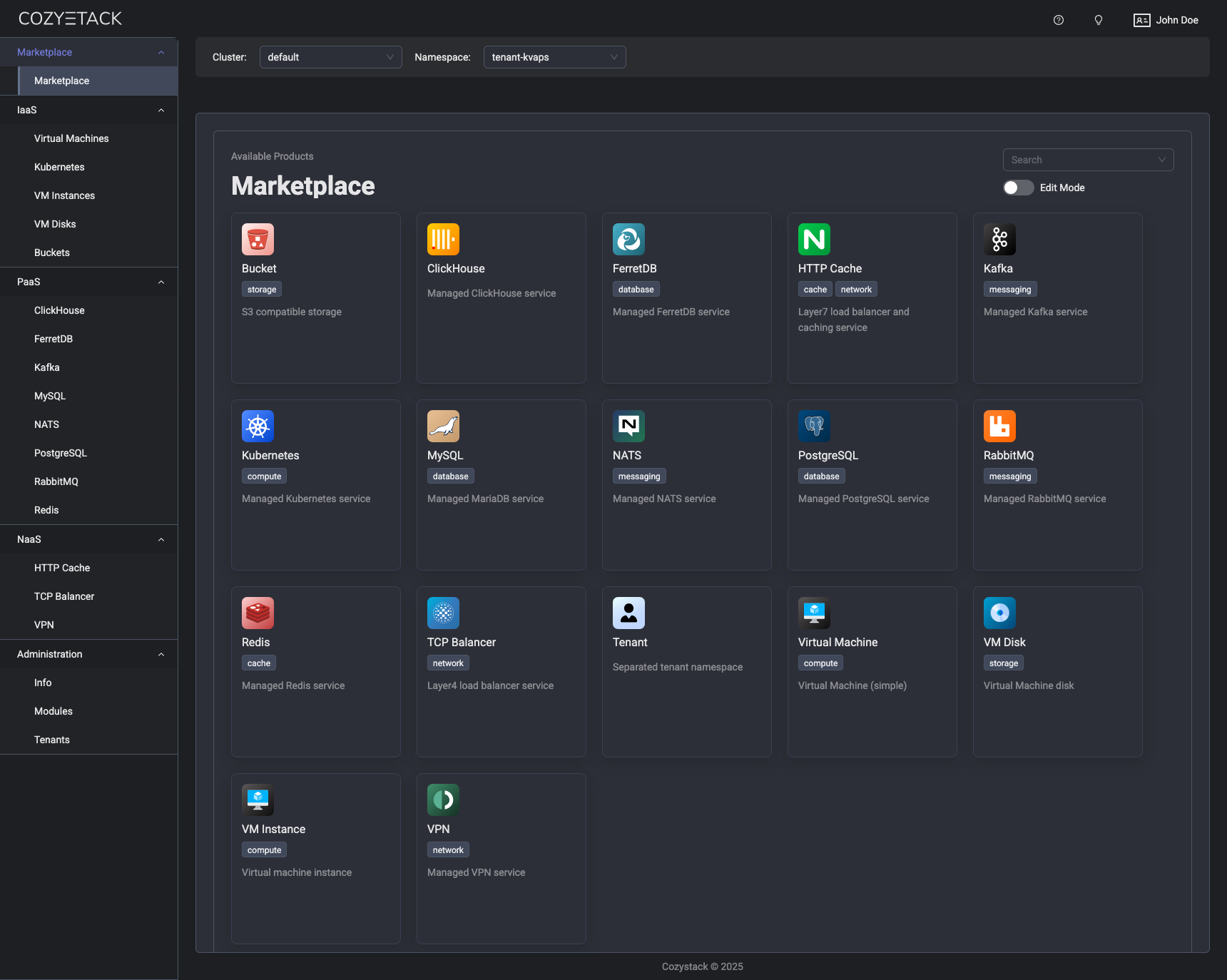
With Cozystack, you can transform a bunch of servers into an intelligent system with a simple REST API for spawning Kubernetes clusters, Database-as-a-Service, virtual machines, load balancers, HTTP caching services, and other services with ease.
Use Cozystack to build your own cloud or provide a cost-effective development environment.
Use-Cases
-
Using Cozystack to build a public cloud
You can use Cozystack as a backend for a public cloud -
Using Cozystack to build a private cloud
You can use Cozystack as a platform to build a private cloud powered by Infrastructure-as-Code approach -
Using Cozystack as a Kubernetes distribution
You can use Cozystack as a Kubernetes distribution for Bare Metal
Documentation
The documentation is located on the cozystack.io website.
Read the Getting Started section for a quick start.
If you encounter any difficulties, start with the troubleshooting guide and work your way through the process that we've outlined.
Versioning
Versioning adheres to the Semantic Versioning principles.
A full list of the available releases is available in the GitHub repository's Release section.
Contributions
Contributions are highly appreciated and very welcomed!
In case of bugs, please check if the issue has already been opened by checking the GitHub Issues section. If it isn't, you can open a new one. A detailed report will help us replicate it, assess it, and work on a fix.
You can express your intention to on the fix on your own. Commits are used to generate the changelog, and their author will be referenced in it.
If you have Feature Requests please use the Discussion's Feature Request section.
Community
You are welcome to join our Telegram group and come to our weekly community meetings. Add them to your Google Calendar or iCal for convenience.
License
Cozystack is licensed under Apache 2.0.
The code is provided as-is with no warranties.
Commercial Support
A list of companies providing commercial support for this project can be found on official site.