 bbe0e8690c
## What this PR does The `vm-instance` chart now drives the cozy-proxy `wholeIP` and `allowICMP` annotations explicitly so that `externalMethod: PortList` actually filters ingress traffic to declared ports while keeping ping/PMTU functional. - Render `networking.cozystack.io/wholeIP: "false"` when `externalMethod: PortList` (was always `"true"`, which silently disabled the PortList semantics in cozy-proxy). - Add `externalAllowICMP` value (default `true`) propagated as `networking.cozystack.io/allowICMP` when `externalMethod: PortList`. Without this, cozy-proxy drops ICMP in port-filter mode (ping/PMTU broken). Operators can set `externalAllowICMP: false` to opt out. The changelog entry is intentionally **not** part of this PR — it will be added in a dedicated `docs: add changelog for vX.Y.Z` commit at release time, per project convention. ## Why `externalMethod: PortList` is documented as filtering ingress traffic to declared ports but has been non-functional on Cozystack v1.3.0 — verified empirically on a 3-node Talos lab. Root cause was twofold: chart always set `wholeIP: "true"`, and cozy-proxy v0.2.0 had no port-aware logic. The cozy-proxy side was fixed in cozystack/cozy-proxy#11 (merged) and cozystack/cozy-proxy#12 (allowICMP follow-up); this PR completes the user-visible fix on the chart side. ## Companion PRs - cozystack/cozy-proxy#11 (merged) — per-service ingress port filtering - cozystack/cozy-proxy#12 (merged) — `allowICMP` annotation for port-filter mode ## Test plan - [x] Built cozy-proxy with the companion fix locally, deployed on a 3-node Talos lab (Cozystack v1.3.0) - [x] `wholeIP: "false"` Service with `spec.ports: [22]`: only port 22 reachable from outside; ports 80/443/8080/9999 filtered - [x] WholeIP-annotated Service unchanged: all listening ports reachable - [x] Egress IP preservation works in both modes (TCP curl + UDP DNS) - [x] `nft list table ip cozy_proxy` confirms expected ruleset - [x] `helm template` renders the expected annotation matrix: `PortList` default → `wholeIP=false, allowICMP=true`; `PortList` opt-out → `allowICMP=false`; `WholeIP` → only `wholeIP=true` - [x] `make unit-tests` passes locally - [ ] CI unit tests - [ ] CI E2E ## Backport Suggesting `backport-v1.3` once merged. ## Release note ```release-note [vm-instance] Make `externalMethod: PortList` actually filter ingress traffic to ports listed in `externalPorts`. New `externalAllowICMP` knob (default true) propagates the cozy-proxy `allowICMP` annotation to keep ping/PMTU functional in port-filter mode. Combined with cozy-proxy v0.3.0+, only listed ports plus ICMP are reachable from the VM's LoadBalancer IP. ``` <!-- This is an auto-generated comment: release notes by coderabbit.ai --> ## Summary by CodeRabbit * **New Features** * Added `externalAllowICMP` configuration option to control ICMP traffic acceptance for VM external access in PortList mode (enabled by default). * **Documentation** * Updated parameter documentation to include the new ICMP traffic control setting. <!-- end of auto-generated comment: release notes by coderabbit.ai --> |
||
|---|---|---|
| .gemini | ||
| .github | ||
| api | ||
| cmd | ||
| dashboards | ||
| docs | ||
| examples/backups/vmi | ||
| hack | ||
| img | ||
| internal | ||
| packages | ||
| pkg | ||
| tools/openapi-gen | ||
| .coderabbit.yaml | ||
| .gitignore | ||
| .pre-commit-config.yaml | ||
| ADOPTERS.md | ||
| AGENTS.md | ||
| CODE_OF_CONDUCT.md | ||
| CONTRIBUTING.md | ||
| CONTRIBUTOR_LADDER.md | ||
| go.mod | ||
| go.sum | ||
| GOVERNANCE.md | ||
| LICENSE | ||
| MAINTAINERS.md | ||
| Makefile | ||
| README.md | ||
| SECURITY.md | ||







Cozystack
Cozystack is a free platform and framework for building clouds.
Cozystack is a CNCF Sandbox Level Project that was originally built and sponsored by Ænix.
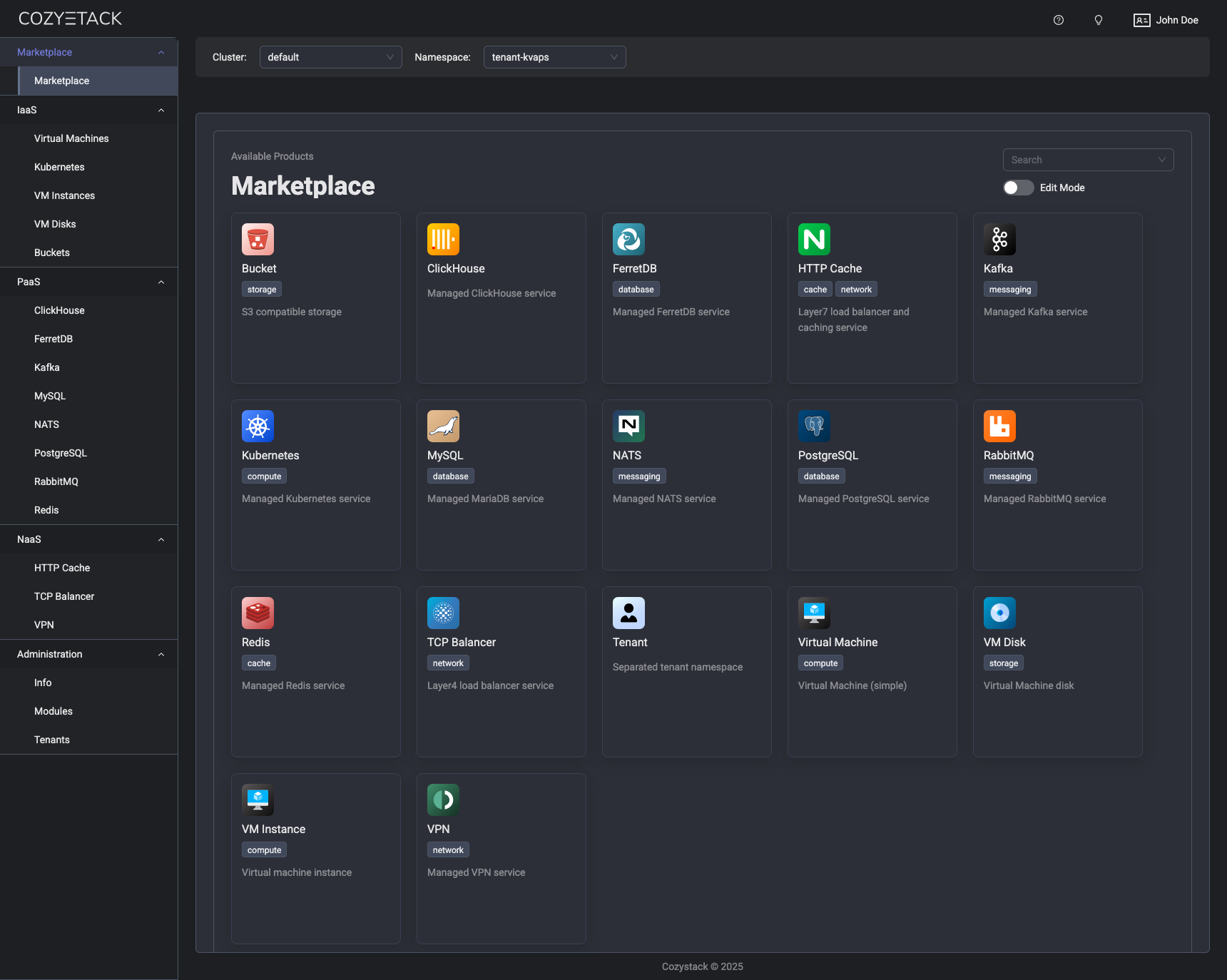
With Cozystack, you can transform a bunch of servers into an intelligent system with a simple REST API for spawning Kubernetes clusters, Database-as-a-Service, virtual machines, load balancers, HTTP caching services, and other services with ease.
Use Cozystack to build your own cloud or provide a cost-effective development environment.
Use-Cases
-
Using Cozystack to build a public cloud
You can use Cozystack as a backend for a public cloud -
Using Cozystack to build a private cloud
You can use Cozystack as a platform to build a private cloud powered by Infrastructure-as-Code approach -
Using Cozystack as a Kubernetes distribution
You can use Cozystack as a Kubernetes distribution for Bare Metal
Documentation
The documentation is located on the cozystack.io website.
Read the Getting Started section for a quick start.
If you encounter any difficulties, start with the troubleshooting guide and work your way through the process that we've outlined.
Versioning
Versioning adheres to the Semantic Versioning principles.
A full list of the available releases is available in the GitHub repository's Release section.
Contributions
Contributions are highly appreciated and very welcomed!
In case of bugs, please check if the issue has already been opened by checking the GitHub Issues section. If it isn't, you can open a new one. A detailed report will help us replicate it, assess it, and work on a fix.
You can express your intention to on the fix on your own. Commits are used to generate the changelog, and their author will be referenced in it.
If you have Feature Requests please use the Discussion's Feature Request section.
Community
You are welcome to join our Telegram group and come to our weekly community meetings. Add them to your Google Calendar or iCal for convenience.
License
Cozystack is licensed under Apache 2.0.
The code is provided as-is with no warranties.
Commercial Support
A list of companies providing commercial support for this project can be found on official site.