 62d2516525
## What this PR does Add an opt-in `upgradeCRDs` field to `ComponentInstall` in `PackageSource`. The field maps directly to `HelmRelease.Spec.Upgrade.CRDs` so a component author can declare how Flux should handle CRDs from the chart's `crds/` directory when the release is upgraded. The helm-controller default on upgrade is `Skip`, which means CRDs added by a chart bump never reach clusters that already have the release installed — they must be applied manually with `kubectl apply --filename charts/.../crds/`. This surfaces on every upgrade of an operator whose CRD set expands between versions (etcd-operator, cnpg, kubevirt, kamaji, etc.). Setting `upgradeCRDs: CreateReplace` lets Flux apply new CRDs declaratively with the chart. Values are restricted to `Skip`, `Create`, `CreateReplace` via a kubebuilder enum marker. Empty / unset preserves the existing helm-controller default, so every current `PackageSource` keeps working unchanged. Migration is out of scope here — follow-ups will opt individual packages in case-by-case. ### Relation to existing CRD management approach The project convention (per #377) is to extract CRDs into a dedicated Helm chart that reconciles ahead of the operator chart. This PR does not replace that pattern — it complements it for charts that keep CRDs inline under `charts/<name>/crds/` where extraction isn't practical (vendored upstream charts with tightly coupled CRDs). Packages that already split CRDs out can leave `upgradeCRDs` unset and keep using their existing separate chart. ### Release note ```release-note feat(operator): add opt-in `upgradeCRDs` field to `PackageSource` component `install` block to control how CRDs from the chart's `crds/` directory are applied on HelmRelease upgrades (`Skip` by default; use `CreateReplace` for operators whose CRD set expands between versions). ``` <!-- This is an auto-generated comment: release notes by coderabbit.ai --> ## Summary by CodeRabbit * **New Features** * Configurable CRD upgrade policy for component installs: Skip, Create, CreateReplace — controls CRD handling during package upgrades and preserves controller default when unset. * **Documentation** * Guidance on CRD upgrade semantics, advice to use CreateReplace for specific operators, and warning about potential data-loss risks; clarified contributor scope examples and PR template guidance. * **Tests** * Added tests validating CRD policy parsing and presence of the CRD policy enum in the published schema. <!-- end of auto-generated comment: release notes by coderabbit.ai --> |
||
|---|---|---|
| .gemini | ||
| .github | ||
| api | ||
| cmd | ||
| dashboards | ||
| docs | ||
| examples/backups/vmi | ||
| hack | ||
| img | ||
| internal | ||
| packages | ||
| pkg | ||
| tools/openapi-gen | ||
| .coderabbit.yaml | ||
| .gitignore | ||
| .pre-commit-config.yaml | ||
| ADOPTERS.md | ||
| AGENTS.md | ||
| CODE_OF_CONDUCT.md | ||
| CONTRIBUTING.md | ||
| CONTRIBUTOR_LADDER.md | ||
| go.mod | ||
| go.sum | ||
| GOVERNANCE.md | ||
| LICENSE | ||
| MAINTAINERS.md | ||
| Makefile | ||
| README.md | ||
| SECURITY.md | ||







Cozystack
Cozystack is a free platform and framework for building clouds.
Cozystack is a CNCF Sandbox Level Project that was originally built and sponsored by Ænix.
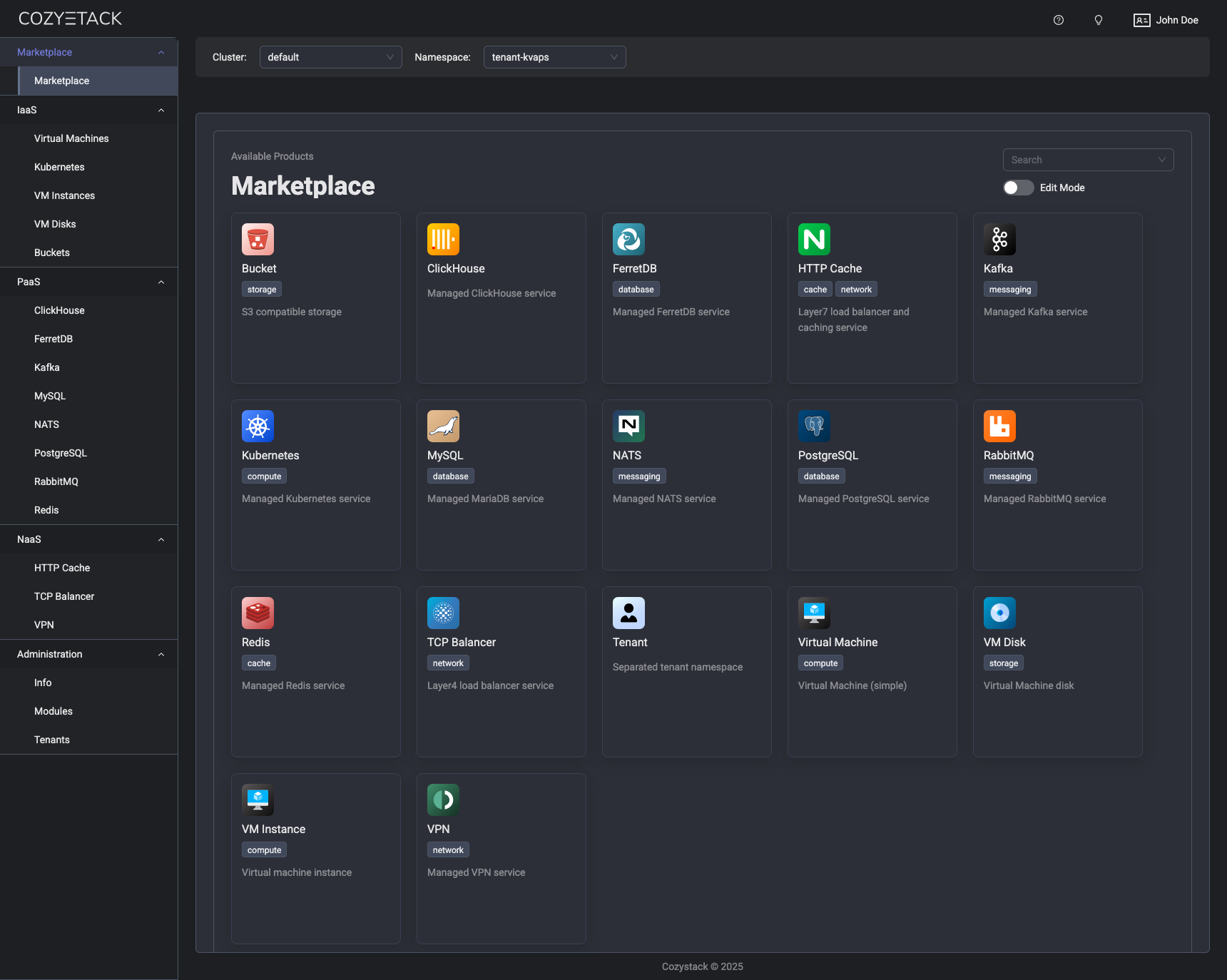
With Cozystack, you can transform a bunch of servers into an intelligent system with a simple REST API for spawning Kubernetes clusters, Database-as-a-Service, virtual machines, load balancers, HTTP caching services, and other services with ease.
Use Cozystack to build your own cloud or provide a cost-effective development environment.
Use-Cases
-
Using Cozystack to build a public cloud
You can use Cozystack as a backend for a public cloud -
Using Cozystack to build a private cloud
You can use Cozystack as a platform to build a private cloud powered by Infrastructure-as-Code approach -
Using Cozystack as a Kubernetes distribution
You can use Cozystack as a Kubernetes distribution for Bare Metal
Documentation
The documentation is located on the cozystack.io website.
Read the Getting Started section for a quick start.
If you encounter any difficulties, start with the troubleshooting guide and work your way through the process that we've outlined.
Versioning
Versioning adheres to the Semantic Versioning principles.
A full list of the available releases is available in the GitHub repository's Release section.
Contributions
Contributions are highly appreciated and very welcomed!
In case of bugs, please check if the issue has already been opened by checking the GitHub Issues section. If it isn't, you can open a new one. A detailed report will help us replicate it, assess it, and work on a fix.
You can express your intention to on the fix on your own. Commits are used to generate the changelog, and their author will be referenced in it.
If you have Feature Requests please use the Discussion's Feature Request section.
Community
You are welcome to join our Telegram group and come to our weekly community meetings. Add them to your Google Calendar or iCal for convenience.
License
Cozystack is licensed under Apache 2.0.
The code is provided as-is with no warranties.
Commercial Support
A list of companies providing commercial support for this project can be found on official site.