 52edffbb9a
## Summary - Increase kamaji controller memory limit from 500Mi to 512Mi - Increase kamaji controller memory request from 100Mi to 256Mi - Add startup probe with 60-second timeout (12 attempts × 5s periods) - Increase readiness/liveness probe initialDelaySeconds from 5s/15s to 30s ## Problem The kamaji controller was experiencing frequent CrashLoopBackOff due to OOMKilled errors. Analysis showed: - Container was being killed with exit code 137 (OOMKilled) after ~20-25 seconds of runtime - Memory limit of 500Mi was insufficient for controller initialization - Readiness probe was failing because it started too early (5s initialDelay), before the controller finished leader election (~17s) ## Solution **Memory increase:** - Limit: 500Mi → 512Mi (based on production testing) - Request: 100Mi → 256Mi (ensures adequate reservation) **Startup probe:** - Added to give controller up to 60 seconds to initialize without being killed by liveness probe - 12 attempts × 5s period = 60s maximum startup time **Probe delays:** - ReadinessProbe: 5s → 30s initialDelay (controller needs ~17s to acquire leader lease) - LivenessProbe: 15s → 30s initialDelay (aligned with readiness) ## Testing Verified in production cluster: - Controller runs stable with 0 restarts - No more OOMKilled events - Successfully creates kubeconfig secrets for tenant clusters ## Related Issues Fixes tenant cluster components stuck in ContainerCreating due to missing kubeconfig secrets (caused by crashing kamaji controller). <!-- This is an auto-generated comment: release notes by coderabbit.ai --> ## Summary by CodeRabbit * **Chores** * Introduced automated health checks using HTTP-based probes to monitor service status during startup, continuous operation, and readiness to handle traffic. * Adjusted container memory resource allocation for enhanced stability and performance. <!-- end of auto-generated comment: release notes by coderabbit.ai --> |
||
|---|---|---|
| .gemini | ||
| .github | ||
| api | ||
| cmd | ||
| dashboards | ||
| docs | ||
| examples/backups/vmi | ||
| hack | ||
| img | ||
| internal | ||
| packages | ||
| pkg | ||
| tools/openapi-gen | ||
| .coderabbit.yaml | ||
| .gitignore | ||
| .pre-commit-config.yaml | ||
| ADOPTERS.md | ||
| AGENTS.md | ||
| CODE_OF_CONDUCT.md | ||
| CONTRIBUTING.md | ||
| CONTRIBUTOR_LADDER.md | ||
| go.mod | ||
| go.sum | ||
| GOVERNANCE.md | ||
| LICENSE | ||
| MAINTAINERS.md | ||
| Makefile | ||
| README.md | ||
| SECURITY.md | ||







Cozystack
Cozystack is a free platform and framework for building clouds.
Cozystack is a CNCF Sandbox Level Project that was originally built and sponsored by Ænix.
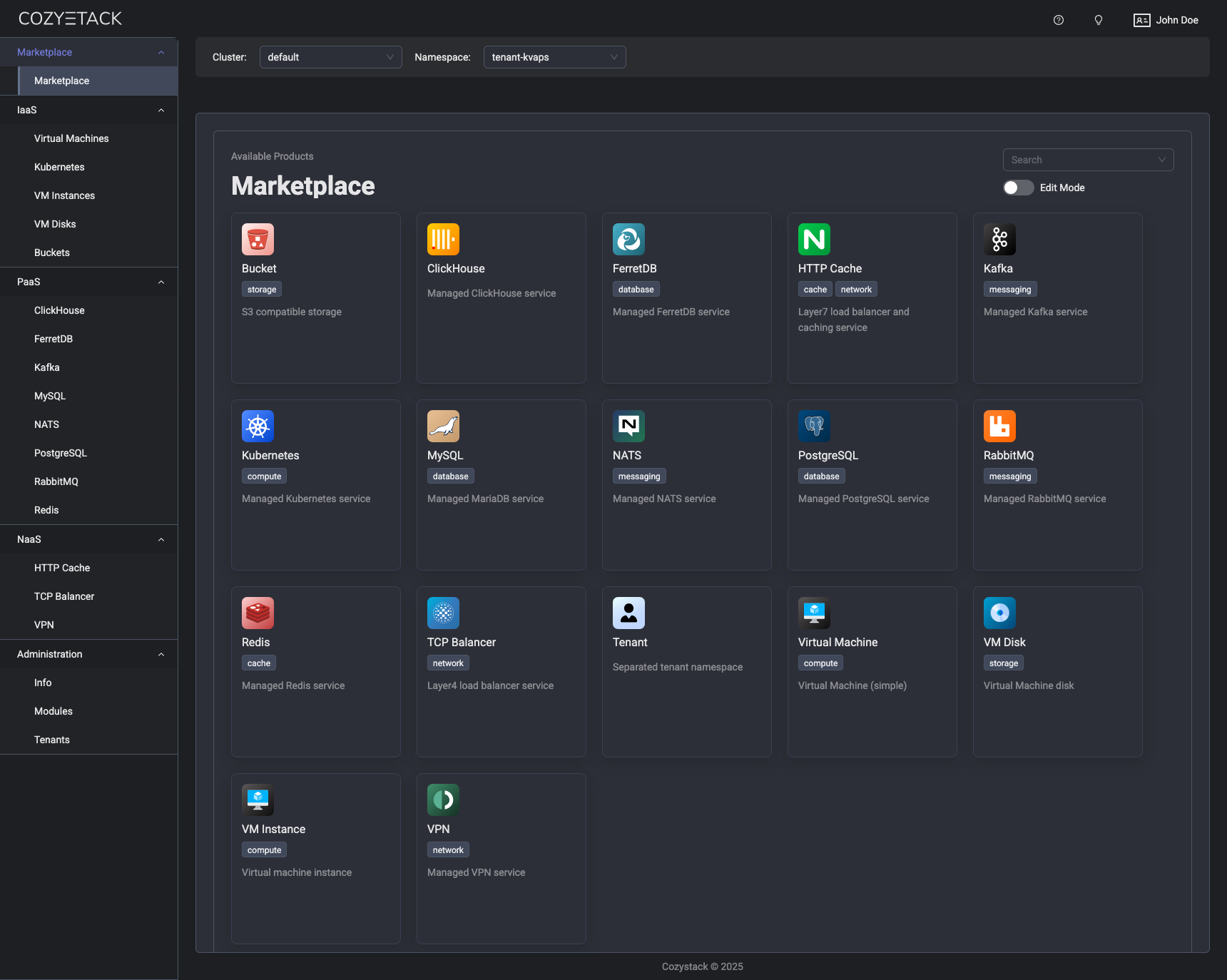
With Cozystack, you can transform a bunch of servers into an intelligent system with a simple REST API for spawning Kubernetes clusters, Database-as-a-Service, virtual machines, load balancers, HTTP caching services, and other services with ease.
Use Cozystack to build your own cloud or provide a cost-effective development environment.
Use-Cases
-
Using Cozystack to build a public cloud
You can use Cozystack as a backend for a public cloud -
Using Cozystack to build a private cloud
You can use Cozystack as a platform to build a private cloud powered by Infrastructure-as-Code approach -
Using Cozystack as a Kubernetes distribution
You can use Cozystack as a Kubernetes distribution for Bare Metal
Documentation
The documentation is located on the cozystack.io website.
Read the Getting Started section for a quick start.
If you encounter any difficulties, start with the troubleshooting guide and work your way through the process that we've outlined.
Versioning
Versioning adheres to the Semantic Versioning principles.
A full list of the available releases is available in the GitHub repository's Release section.
Contributions
Contributions are highly appreciated and very welcomed!
In case of bugs, please check if the issue has already been opened by checking the GitHub Issues section. If it isn't, you can open a new one. A detailed report will help us replicate it, assess it, and work on a fix.
You can express your intention to on the fix on your own. Commits are used to generate the changelog, and their author will be referenced in it.
If you have Feature Requests please use the Discussion's Feature Request section.
Community
You are welcome to join our Telegram group and come to our weekly community meetings. Add them to your Google Calendar or iCal for convenience.
License
Cozystack is licensed under Apache 2.0.
The code is provided as-is with no warranties.
Commercial Support
A list of companies providing commercial support for this project can be found on official site.