 1436fee2dd
## What this PR does Adds a host preflight diagnostic script (`hack/check-host-runtime.sh`) that warns operators when a standalone `containerd.service` or `docker.service` is running on the host alongside the embedded k3s runtime used by the cozystack `generic` variant (k3s / kubeadm on Ubuntu). **Why it matters.** K3s ships its own containerd at `/run/k3s/containerd/containerd.sock` and `/var/lib/rancher/k3s/agent/containerd`, while a system-package containerd or docker uses `/run/containerd/containerd.sock` and `/var/lib/containerd`. The two runtimes do not fight over sockets, so both keep running silently. Over time the standalone one accumulates unpruned images and build cache in `/var/lib/containerd` — enough to fill the root disk, trigger `DiskPressure`, and put `cozystack-api` into an eviction loop. This is silent on day zero and surfaces as a mysterious production incident weeks later. The script exists to warn the next operator before the failure mode surfaces. The script is warning-only — it always exits 0 and never blocks the install. It detects: - `containerd.service` or `docker.service` active via `systemctl is-active` - Standalone runtime sockets at well-known paths, with a fallback that works on hosts without systemd - Standalone data directory sizes via `du -sh` When a warning fires, the HINT names only the detected services and instructs the operator to disable them with `sudo systemctl disable --now <service>`. Reclaiming the data directory is called out separately with an explicit note not to delete it blindly — the data may still be in use. **Entry points.** - `make preflight` runs the script directly (for operators preparing a generic-variant host) - `make unit-tests` now runs `bats-unit-tests` alongside `helm-unit-tests`, auto-discovering every `hack/*.bats` file that is not an e2e test **Test coverage.** `hack/check-host-runtime.bats` (11 cases, run via `hack/cozytest.sh`) covers clean hosts with and without systemd, single-service detection, both services simultaneously, socket-only fallback for both runtimes, glob-expansion regression guard, explicit exit-code-0 assertion, `sudo` prefix assertion, `du` failure robustness, and the "service + socket = exactly one warning" de-duplication invariant. Every test is self-contained with `trap 'rm -rf $STUB_DIR' EXIT` for clean recovery on assertion failure, and has no runtime dependencies beyond bash and core utilities — no python3, no real systemd. Irrelevant on Talos where the container runtime lifecycle is fully managed by the distribution. ### Release note ```release-note [hack] Add `check-host-runtime.sh` and `make preflight` target that warn when a standalone containerd or docker runtime is running alongside the embedded k3s runtime on the cozystack generic variant. ``` <!-- This is an auto-generated comment: release notes by coderabbit.ai --> ## Summary by CodeRabbit * **New Features** * Added a non-blocking preflight check that detects standalone container runtimes, reports disk-usage estimates, and displays an actionable hint to disable detected services. * **Tests** * Added BATS-based unit tests with comprehensive coverage for the preflight validations and various host scenarios. * **Chores** * Build updated to run the BATS unit tests alongside the existing test suite. <!-- end of auto-generated comment: release notes by coderabbit.ai --> |
||
|---|---|---|
| .github | ||
| api | ||
| cmd | ||
| dashboards | ||
| docs | ||
| examples/backups/vmi | ||
| hack | ||
| img | ||
| internal | ||
| packages | ||
| pkg | ||
| tools/openapi-gen | ||
| .gitignore | ||
| .pre-commit-config.yaml | ||
| ADOPTERS.md | ||
| AGENTS.md | ||
| CODE_OF_CONDUCT.md | ||
| CONTRIBUTING.md | ||
| CONTRIBUTOR_LADDER.md | ||
| go.mod | ||
| go.sum | ||
| GOVERNANCE.md | ||
| LICENSE | ||
| MAINTAINERS.md | ||
| Makefile | ||
| README.md | ||
| SECURITY.md | ||







Cozystack
Cozystack is a free PaaS platform and framework for building clouds.
Cozystack is a CNCF Sandbox Level Project that was originally built and sponsored by Ænix.
With Cozystack, you can transform a bunch of servers into an intelligent system with a simple REST API for spawning Kubernetes clusters, Database-as-a-Service, virtual machines, load balancers, HTTP caching services, and other services with ease.
Use Cozystack to build your own cloud or provide a cost-effective development environment.
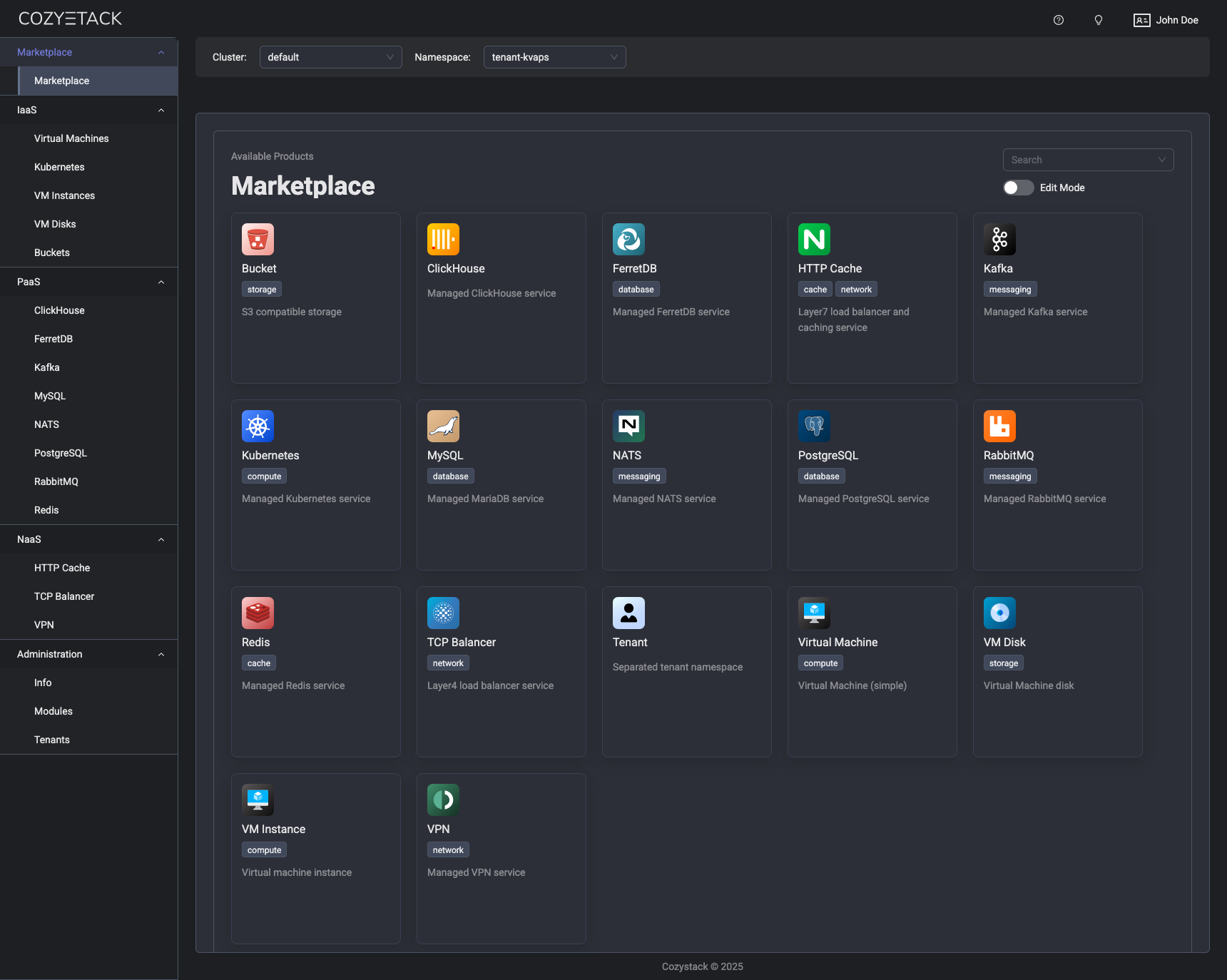
Use-Cases
-
Using Cozystack to build a public cloud
You can use Cozystack as a backend for a public cloud -
Using Cozystack to build a private cloud
You can use Cozystack as a platform to build a private cloud powered by Infrastructure-as-Code approach -
Using Cozystack as a Kubernetes distribution
You can use Cozystack as a Kubernetes distribution for Bare Metal
Documentation
The documentation is located on the cozystack.io website.
Read the Getting Started section for a quick start.
If you encounter any difficulties, start with the troubleshooting guide and work your way through the process that we've outlined.
Versioning
Versioning adheres to the Semantic Versioning principles.
A full list of the available releases is available in the GitHub repository's Release section.
Contributions
Contributions are highly appreciated and very welcomed!
In case of bugs, please check if the issue has already been opened by checking the GitHub Issues section. If it isn't, you can open a new one. A detailed report will help us replicate it, assess it, and work on a fix.
You can express your intention to on the fix on your own. Commits are used to generate the changelog, and their author will be referenced in it.
If you have Feature Requests please use the Discussion's Feature Request section.
Community
You are welcome to join our Telegram group and come to our weekly community meetings. Add them to your Google Calendar or iCal for convenience.
License
Cozystack is licensed under Apache 2.0.
The code is provided as-is with no warranties.
Commercial Support
A list of companies providing commercial support for this project can be found on official site.