|
|
||
|---|---|---|
| .github | ||
| hyperdbg | ||
| utils | ||
| .gitattributes | ||
| .gitignore | ||
| .gitmodules | ||
| CHANGELOG.md | ||
| CITATION.cff | ||
| CODE_OF_CONDUCT.md | ||
| CONTRIBUTING.md | ||
| CREDITS.md | ||
| doxyfile | ||
| HOWTO.md | ||
| LICENSE | ||
| README.md | ||





HyperDbg Debugger
HyperDbg Debugger is an open-source, community-driven, hypervisor-assisted, user-mode, and kernel-mode Windows debugger with a focus on using modern hardware technologies. It is a debugger designed for analyzing, fuzzing, and reversing.
Follow HyperDbg on Twitter to get notified about new releases, and join Telegram group to connect with the community of developers and debugging enthusiasts and get your questions about HyperDbg answered!
Description
HyperDbg is designed with a focus on using modern hardware technologies to provide new features to the debuggers' world. It operates on top of Windows by virtualizing an already running system using Intel VT-x and Intel PT. This debugger aims not to use any APIs and software debugging mechanisms, but instead, it uses Second Layer Page Table (a.k.a. Extended Page Table or EPT) extensively to monitor both kernel and user executions.
Using TLB-splitting, and having features such as measuring code coverage and monitoring all mov(s) to/from memory by a function, makes HyperDbg a unique debugger.
Although it has novel features, HyperDbg tries to be as stealthy as possible. It doesn’t use any debugging APIs to debug Windows or any application, so classic anti-debugging methods won’t detect it. Also, it resists the exploitation of time delta methods (e.g., RDTSC/RDTSCP) to detect the presence of hypervisors, therefore making it much harder for applications, packers, protectors, malware, anti-cheat engines, etc. to discover the debugger.
Build & Installation
You can download the latest compiled binary files from releases; otherwise, if you want to build HyperDbg, you should clone HyperDbg with the --recursive flag.
git clone --recursive https://github.com/HyperDbg/HyperDbg.git
Please visit Build & Install and Quick Start for a detailed explanation of how to start with HyperDbg. You can also see the FAQ for more information, or if you previously used other native debuggers like GDB, LLDB, or WinDbg, you could see the command map.
Publications
In case you use one of HyperDbg's components in your work, please consider citing our paper.
1. HyperDbg: Reinventing Hardware-Assisted Debugging (CCS'22) [arXiv]
@inproceedings{karvandi2022hyperdbg,
  title={HyperDbg: Reinventing Hardware-Assisted Debugging},
  author={Karvandi, Mohammad Sina and Gholamrezaei, MohammadHosein and Khalaj Monfared, Saleh and Meghdadizanjani, Soroush and Abbassi, Behrooz and Amini, Ali and Mortazavi, Reza and Gorgin, Saeid and Rahmati, Dara and Schwarz, Michael},
  booktitle={Proceedings of the 2022 ACM SIGSAC Conference on Computer and Communications Security},
  pages={1709--1723},
  year={2022}
}
You can also read this article as it describes the overall architecture, technical difficulties, design decisions, and internals of HyperDbg Debugger, this article about our efforts on vm-exit transparency, and this article about chasing bugs within hypervisors. More articles, posts, and resources are available at the awesome repo, and in addition, the slides repo provides presentation slides for further reference.
Unique Features
First Release (v0.1.0.0)
- Advanced Hypervisor-based Kernel Mode Debugger [link][link][link]
- Classic EPT Hook (Hidden Breakpoint) [link][link][link]
- Inline EPT Hook (Inline Hook) [link][link]
- Monitor Memory For R/W (Emulating Hardware Debug Registers Without Limitation) [link][link][link]
- SYSCALL Hook (Disable EFER & Handle #UD) [link][link][link]
- SYSRET Hook (Disable EFER & Handle #UD) [link][link]
- CPUID Hook & Monitor [link][link]
- RDMSR Hook & Monitor [link][link]
- WRMSR Hook & Monitor [link][link]
- RDTSC/RDTSCP Hook & Monitor [link]
- RDPMC Hook & Monitor [link]
- VMCALL Hook & Monitor [link]
- Debug Registers Hook & Monitor [link]
- I/O Port (In Instruction) Hook & Monitor [link][link]
- I/O Port (Out Instruction) Hook & Monitor [link][link]
- MMIO Monitor [link]
- Exception (IDT < 32) Monitor [link][link][link]
- External-Interrupt (IDT > 32) Monitor [link][link][link]
- Running Automated Scripts [link]
- Transparent-mode (Anti-debugging and Anti-hypervisor Resistance) [link][link]
- Running Custom Assembly In Both VMX-root, VMX non-root (Kernel & User) [link]
- Checking For Custom Conditions [link][link]
- Process-specific & Thread-specific Debugging [link][link][link]
- VMX-root Compatible Message Tracing [link]
- Powerful Kernel Side Scripting Engine [link][link]
- Support To Symbols (Parsing PDB Files) [link][link]
- Mapping Data To Symbols & Create Structures, Enums From PDB Files [link][link][link]
- Event Forwarding (#DFIR) [link][link]
- Transparent Breakpoint Handler [link][link]
- Various Custom Scripts [link]
Second Release (v0.2.0.0)
- HyperDbg Software Development Kit (SDK) [link]
Third Release (v0.3.0.0)
- Event Short-circuiting [link][link]
- Tracking records of function calls and return addresses [link]
- Kernel-level Length Disassembler Engine (LDE) [link][link]
Fourth Release (v0.4.0.0)
How does it work?
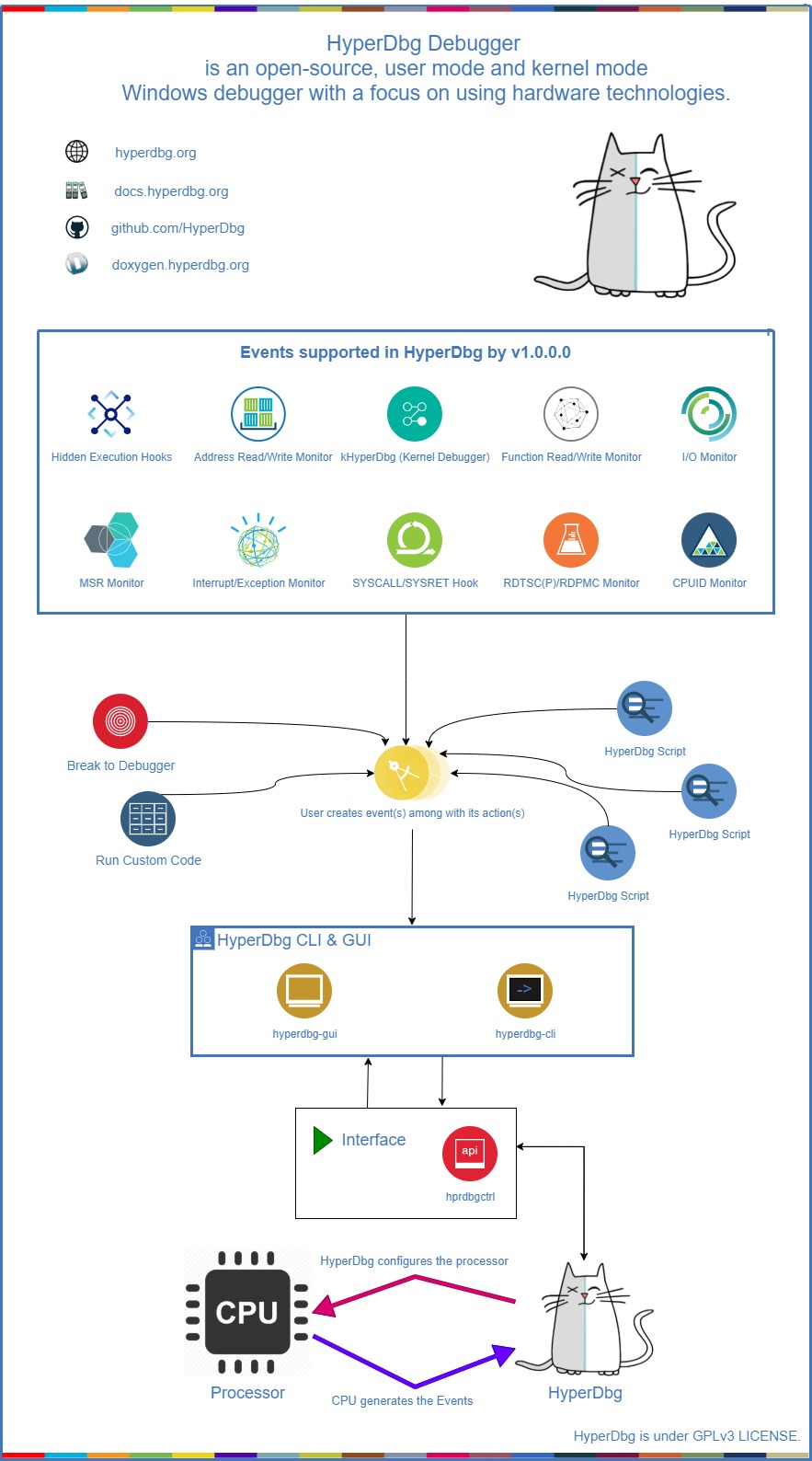
You can read about the internal design of HyperDbg and its features in the documentation. Here's a top-level diagram that shows how HyperDbg works:
Scripts
You can write your scripts to automate your debugging journey. HyperDbg has a powerful, fast, and entirely kernel-side implemented script engine.
Contributing
Contributing to HyperDbg is super appreciated. We have made a list of potential tasks that you might be interested in contributing towards.
If you want to contribute to HyperDbg, please read the Contribution Guide.
License
HyperDbg, and all its submodules and repos, unless a license is otherwise specified, are licensed under GPLv3 LICENSE.
Dependencies are licensed by their own.